
Cosmology
Cosmology is a branch of physics concerned with structure, history, and composition of the Universe as a whole. Over the past century our understanding of cosmology has grown dramatically, and we are now able to say with high confidence that the Universe is roughly homogeneousMatter is evenly distributed across the Universe when you consider the average over scales larger than about 300 million light years. There is no preferred location, ie. no "center." and isotropicMatter is distributed evenly in all directions as seen from any particular location. There is no preferred direction in the Universe. on the largest scales and that it has expanded from a hot, dense initial state (the Big BangA model based on General Relativity in which the Universe expanded (and continues to expand) from an initial state that was hot and dense everywhere.). We know the Universe is expanding because we observe distant galaxies all moving away from us at a rate that increases with their distance from us; if space were not stretching out with time we would expect some of them to be moving toward us and others to be moving away. We know that the Universe was originally hot and dense because we are surrounded by the nearly uniform light emitted when the Universe became cool enough for atoms to form -- the cosmic microwave background (CMB)Often called the "afterglow" of the Big Bang, the CMB is residual light originating about 380,000 years after the Big Bang. As the Universe has expanded the light has cooled. The temperature of the universe when the light was emitted was around 3000 Kelvin (around 2700º Celsius). The light we detect now corresponds to a temperature of 2.7260 Kelvin, so it appears in the form of microwaves today..
Additionally, the Universe very likely went through an early phase of extremely rapid, accelerating expansion called inflationEarly period of accelerating expansion lasting perhaps 10-32 seconds, driven by something similar to dark energy.. Large-scale sound waves produced by this rapid expansion can be detected as slight ripples in the CMB. These ripples are superimposed on a pattern of random noise that originated in microscopic fluctuations (quantum fluctuationsMicroscopic variation in matter and force fields arising from quantum mechanical uncertainty.) in matter and force fields that existed before inflation blew them up to galaxy size.
The evidence we have accumulated also strongly suggests that most of the mass-energyAccording to Special Relativity, mass and energy are two aspects of the same phenomenon content, linked by Einstein's famous equation E=mc2. In General Relativity, both contribute to the gravitational field, so we speak of "mass-energy." of the Universe exists in a form other than normal (atomic) matter. Dark matterHypothetical form of matter that feels only the force of gravity and at best weakly interacts with normal matter. is about 27% of the total; it clumps together under the influence of gravity but interacts at best very weakly with light or with ordinary matter via electromagnetic or nuclear forces. Dark energyName given by physicists to the form of energy causing the expansion of the Universe to accelerate., an even more mysterious phenomenon that interacts with gravity in a repulsive fashion, makes up 68% of the total and is causing the Universe to expand faster with time rather than slowing down with time. Ordinary atoms -- the stuff we are made of -- constitute less than 5% of the total.
The fluctuations in the distribution of matter that were imprinted in the CMB eventually grew into the galaxies and clusters of galaxies we see today through the process of gravitational instabilityTendency for gravity to collect matter in places where it is initially denser, emptying out regions where it is initially less dense.. Among these structures is our own Milky Way Galaxy and the Local GroupOur Local Group comprises over 50 galaxies. Most of them are small dwarf galaxies, but there are some larger ones like the Milky Way. The Local Group is a structure about 10 Mly (million light years) across. of galaxies. This includes galaxies and objects nearby, such as the Andromeda galaxy. Our Local Group is a part of an even larger structure called a superclusterSuperclusters are the largest structures in the universe (though they are not gravitationally bound). These are fundamentally clusters of clusters. The diameters of superclusters are on the order of hundreds of millions of light years. . We are a part of the Laniakea SuperclusterWe are in the Laniakea Supercluster. Originally, it was thought that we were a part of the Virgo Supercluster, but it turns out that Virgo is actually a part of Laniakea. The Laniakea supercluster stretches 519 million light years across at its widest part and contains over 300 clusters of galaxies or around 100,000 galaxies in total. . Whereas galaxies and clusters of galaxies are relatively compact, superclusters are organized into filamentsClusters and galaxies are organized into long strands averaging 200 million light years long. It is believed that matter condensed around dark matter strings or webs, and that is why the galaxies form filaments on the grandest of scales. . The filamentary web of large-scale structure delineates huge galaxy-free expanses known as voidsWhere there are not filaments, there are voids. These are relatively empty regions of space where few galaxies reside. .
Image credits: "WMAP image of the CMB anisotropy" - NASA; "Universe expansion2" - Gnixon


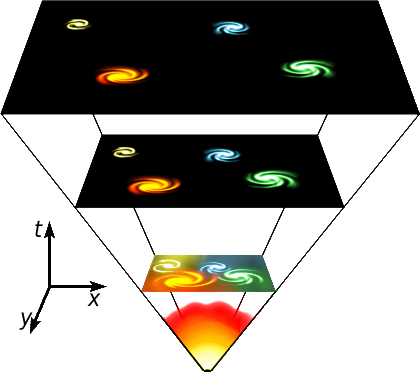
Expansion of the Universe.
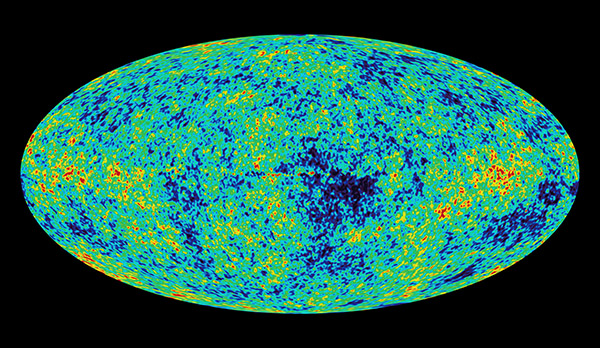
The cosmic microwave background radiation.
Computer simulations of gravitational instability produce filaments and voids.