
Galaxies
GalaxiesGalaxies are huge collections of stars, gas, and dark matter, bound together by gravity. have a variety of shapes and sizes. Dwarf galaxies are a few thousand light yearsA light year is the distance light can travel in one year, about 6 trillion miles or 9 trillion kilometers. across and contain thousands of stars. Giants can be 100 times bigger and contain trillions of stars. Spiral galaxiesGalaxies with flattened stellar disks, supported against gravity by rotation. have beautiful spiral arms and plenty of gas and dust, while elliptical galaxiesGalaxies whose stars are distributed in an elliptical or spherical shape, supported against gravity by their random motions. are more blob-like and host little gas or dust. Spiral galaxies may have few or many spiral arms, and most have a collection of stars in the center, the bulge, that looks like a small elliptical galaxy. Elliptical galaxies vary in their roundness; some are more flat like a pancake and others are more like a ball.
The earliest known galaxies formed just 200 million years after the Big Bang. It is thought that they formed when hot gas cooled and fell into large halosA halo is a more-or-less round collection of matter bound by gravity but not subject to pressure forces. Usually used to refer to the dark matter component of galaxies and clusters of galaxies. of dark matterA form of matter not made of atoms that interacts with atoms only via the force of gravity. Dark matter does not interact with light and so does not glow or scatter or absorb light.. Most of the earliest galaxies merged with other galaxies to form the big ones we see today. Much is still not understood about this process; in particular, most galaxies seem to host supermassive black holesA black hole results when so much matter is collected in one place that not even light can escape its gravitational field. Some black holes with masses a few times that of the Sun are formed in supernova explosions, while supermassive black holes have masses millions or billions of times that of the Sun and are found at the centers of galaxies., and little is known about how these objects originally formed.
Galaxies sometimes collide in spectacular displays. During a galaxy collision, the gravitational field of each galaxy warps and twists the other one. However, since the stars within a galaxy are so far apart, they almost never directly collide. Sometimes the collision of gas clouds can create new stars, lighting up the places where the galaxies are coming together. Our own Milky WayThe galaxy in which we live. is actually in the process of absorbing several dwarf galaxies, but we barely notice because the dwarf galaxies are so small compared to our own. When colliding galaxies are of similar mass, their collisions produce huge changes in the structure of both galaxies. The Milky Way will itself collide with the similarly-sized Andromeda GalaxyNearest large spiral galaxy to our own. in about 4 billion years.
Spiral Galaxy Simulator
Our spiral galaxy simulation follows the orbits of stars in the disk of a model dark matter halo. Movies show the positions of particles that stand in for the stars, each of which obeys Newton's laws with the gravitational force depending on which type of halo is assumed. Some models produce spiral patterns, while others do not. Check out some of our precomputed spiral galaxy simulations below.
| Potential Type | Potential Solver | Integration Method | Number of Particles |
|---|---|---|---|
| Power Law | No Self Gravity | Leapfrog | 10000 |
| Power Law | No Self Gravity | 5th Order Runge-Kutta | 10000 |
| Power Law | No Self Gravity | Self Gravity Leapfrog | 10000 |
| Power Law | Direct Force Summation | Leapfrog | 10000 |
| Power Law | Direct Force Summation | Self Gravity Leapfrog | 10000 |
| Homogeneous Sphere | Direct Force Summation | Leapfrog | 10000 |
| Galaxy Potential | No Self Gravity | Self Gravity Leapfrog | 10000 |
Image credits: "Super Star Clusters in the Antennae Galaxies" - NASA, ESA, and the Hubble Heritage Team (STScI/AURA)-ESA/Hubble Collaboration; "Hubble's Deepest View of the Universe Unveils Bewildering Galaxies across Billions of Years" - NASA; ESA; G. Illingworth, D. Magee, and P. Oesch, University of California, Santa Cruz; R. Bouwens, Leiden University; and the HUDF09 Team; "The Planet, the Galaxy and the Laser" - ESO/Y. Beletsky
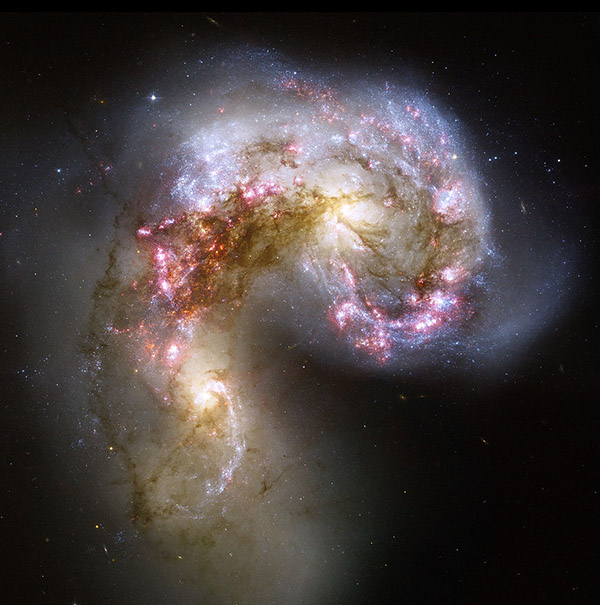
The Antennae, a pair of colliding galaxies.
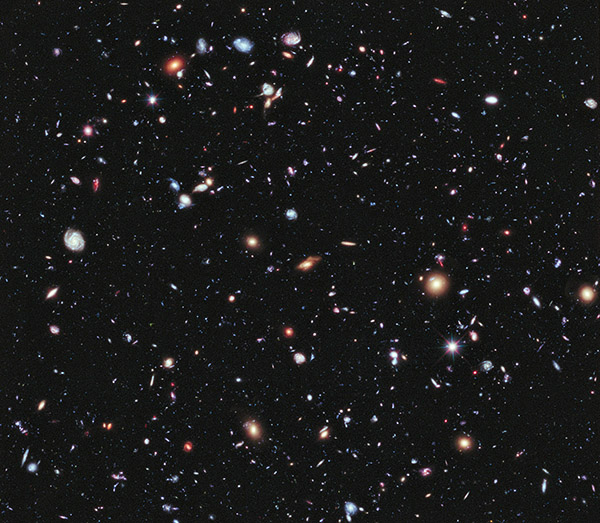
The Hubble Deep Field contains many galaxies.
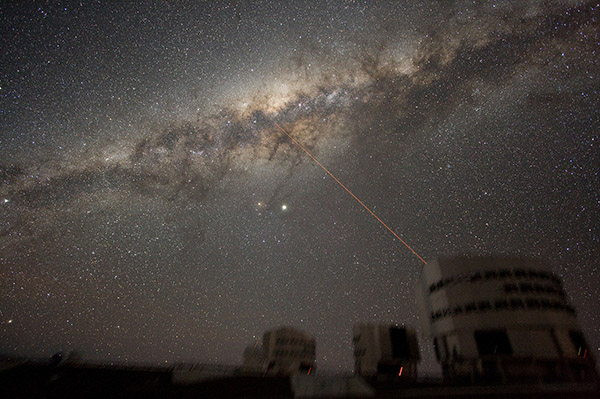
The Milky Way's center as seen from Earth.