
Gases
Most of the atoms in the Universe exist in the form of gasFluid state of matter in which atoms are electrically neutral and collide but are not as tightly bound together as in a liquid. or plasmaA plasma is a gas in which the atoms have been stripped of one or more of their electrons, becoming ions.. The equations of fluid dynamicsThe study of fluids (gases, plasmas, or liquids) in motion. Also referred to as hydrodynamics in some contexts. describe how the density, velocity, and temperature of gases and plasmas vary in time and space due to the influence of pressure forces, gravity, radiation, and magnetic fields (the last of these is called magnetohydrodynamicsThe study of the behavior of electrically conductive fluids. or MHD). Because of the complexity of these equations and the flows encountered in real life, often fluid dynamics problems must be solved using computer simulations.
Unlike a solid, the particles that make up a gas or plasma are constantly in motion with a range of speeds. The average speed depends on the temperature and is close to the speed at which sound waves propagate in the fluid (the speed of soundSpeed at which sound waves move in a fluid.). Information about disturbances in a fluid moves at the speed of sound except when very strong disturbances are created, as with an explosion. Strong disturbances can create shock wavesDisturbance in a fluid that abruptly changes the density, pressure, and velocity. Shock waves move at speeds faster than the speed of sound. that move through a fluid and compress and heat it. Shock waves are very common in astrophysics, so it is important that the numerical methods used in astrophysical simulations be able to handle shocks well.
Among the most interesting problems in fluid dynamics are instabilitiesA fluid in equilibrium is said to be unstable if a small change tends to amplify itself rather than damping out.. Several instabilities are common in astrophysics. The Kelvin-Helmholtz instabilityInstability of shear layers in a fluid. amplifies disturbances wherever two layers of fluid are moving past (shearing against) each other. The Rayleigh-Taylor instabilityInstability occurring when a fluid experiences acceleration in the direction of lower density. occurs when a denser fluid lies on top of a less-dense fluid. Convective instabilityInstability occurring when a fluid experiences acceleration in the direction of higher entropy. occurs when a fluid is heated from below (as in some parts of the interiors of stars). The Jeans instabilityInstability of cold, self-gravitating fluids. occurs when pressure is unable to withstand gravity, causing a fluid to collapse under its own weight (as during the process of star formation). As with shock waves, it is important that numerical methods used in astrophysical simulations be able to handle these instabilities well.
One-dimensional hydrodynamics simulator
This simulator is used to study the behavior of different kinds of one-dimensional hydrodynamic and magnetohydrodynamic waves.
| Name of Video | Description |
|---|---|
| Brio-Wu shock tube | A shock wave in a magnetized plasma. |
| Entropy wave | A shock-like disturbance that separates two masses of fluid that do not mix. |
| Sound wave | A sound wave without the effects of self-gravity. |
| Stable self-gravitating sound wave | A sound wave that is stable against the Jeans instability. |
| Unstable self-gravitating sound wave | A sound wave demonstrating the Jeans instability. |
| Alfven wave | A type of traveling MHD wave. |
Two-dimensional hydrodynamics simulator
This simulator is used to study the behavior of different kinds of two-dimensional hydrodynamic and magnetohydrodynamic instabilities.
| Name of Video | Description |
|---|---|
| Weak gravity, weak magnetic field | This model shows collapse using minimal self-gravity and magnetic field. |
| Strong gravity, weak magnetic field | This model shows collapse under the influence of strong self-gravity with minimal magnetic field. |
| Weak gravity, strong magnetic field | This model shows collapse under the influence of a strong magnetic field with minimal self-gravity. |
| Strong gravity, strong magnetic field | This model shows collapse under the influence of strong self-gravity and magnetic field. |
Image credits: "airbos_f7_p5" - NASA; "Wave clouds forming over Mount Duval, NSW" - GRAHAMUK, user of the English language Wikipedia (CC BY SA 3.0 ); "HD-Rayleigh-Taylor" - Shengtai Li, Hui Li - "Parallel AMR Code for Compressible MHD or HD Equations" Unless otherwise indicated, this information has been authored by an employee or employees of the University of California, operator of the Los Alamos National Laboratory under Contract No. W-7405-ENG-36 with the U.S. Department of Energy. The U.S. Government has rights to use, reproduce, and distribute this information. The public may copy and use this information without charge, provided that this Notice and any statement of authorship are reproduced on all copies. Neither the Government nor the University makes any warranty, express or implied, or assumes any liability or responsibility for the use of this information.


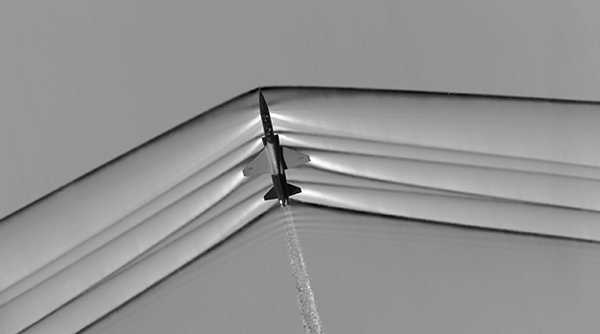
Shock waves caused by a supersonic jet airplane.
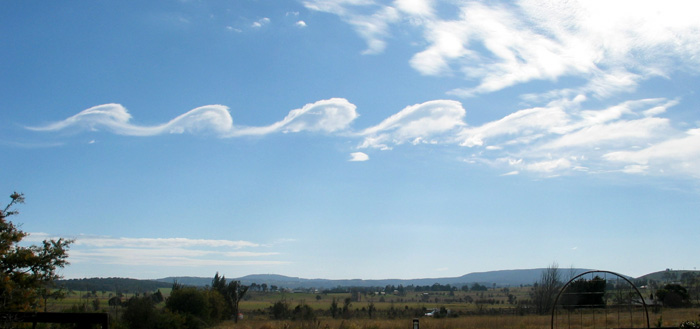
Clouds exhibiting the Kevin-Helmholtz instability in Mount Duval, Australia.
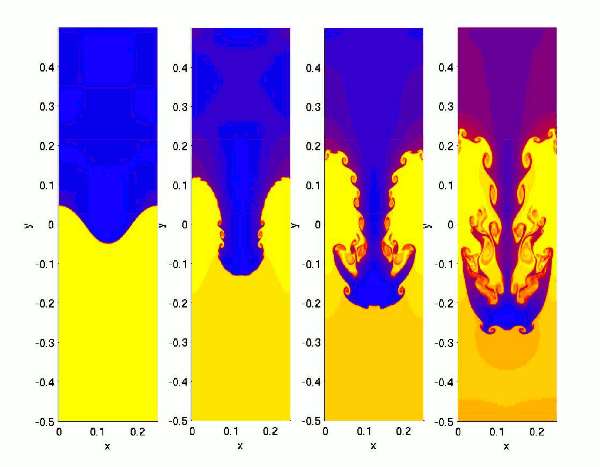
Computer simulation of the Rayleigh-Taylor instability.