
The interstellar medium
Between the stars in galaxies lies the interstellar mediumTenuous gas and dust between the stars. (ISM), a vast expanse of extremely tenuous gas and dust. The ISM consists mostly of hydrogen atoms and molecules, with smaller amounts of helium and other elements and, in some regions, more complex molecules like water, carbon dioxide, and ammonia. Even though there is barely anything in it compared to our atmosphere, its very low density (1 atom or molecule for every cubic centimeter on average) actually adds up to a significant amount of mass over distances of light years.
If you look at the clear night sky when far away from civilization, you will see the Milky WayFaint band of light in the night sky corresponding to the disk of our Galaxy, also called the Milky Way.. Although the Milky Way appears brighter than other parts of the sky, it is actually much fainter than it would be without the ISM. This is because the light from the stars in the Galaxy's disk interacts with the dust between those stars and Earth. Light scatters off of dust particles, making luminous objects appear dimmer (extinctionScattered light does not reach us, so we receive less light than we would otherwise.) and redder (reddeningDust preferentially scatters blue (shorter wavelength) light, leaving behind red (longer wavelength) light.).
With a good telescope, one can see faint, diffuse objects in the night sky called nebulaeClouds of gas and dust in the ISM that are distinguished by the light they emit, absorb, or scatter.. Emission nebulae shine because they contain hot gases. Reflection nebulae shine by light reflected from nearby stars (this is where the light scattered by dust goes). Nebulae can also take the form of dark clouds that can only be detected in visible light because they block the light from more distant sources.
The ISM is intimately connected to the life cycle of stars. Stars form deep within dust-shrouded regions inside dense, cold molecular cloudsAn ISM cloud consisting mostly of molecular hydrogen (H2) with a density of 100 molecules per cubic centimeter or so and a temperature of 1 to 100 degrees above absolute zero.. As nuclear reactions turn on and a star begins to shine, it heats up and pushes away the surrounding gas. Most stars also produce a stellar windSteady stream of atoms and ions blown off the surface of a star in all directions. that pushes against the ISM, producing sometimes-dramatic bow shocksA sharp boundary between two regions of gas created by supersonic flow.. During the late stages of life of a star like the Sun, the star's wind intensifies until it blows off all of its outer layers into a colorful planetary nebulaAn unfortunate name, since it has nothing to do with planets. Planetary nebulae are colorful emission nebulae produced when a low-mass star at the end of its life ejects much of its mass into the ISM.. Massive stars that end their lives as supernovae also eject hot gas in the form of supernova remnantsRoughly spherical cloud of expanding hot gas produced by a supernova explosion..
Image credits: "Interstellar dust clouds in the constellation of Orion" - NASA; "Landscape Carina Nebula" - NASA, ESA, and M. Livio, The Hubble Heritage Team and the Hubble 20th Anniversary Team (STScI); "52706main hstorion lg" - NASA


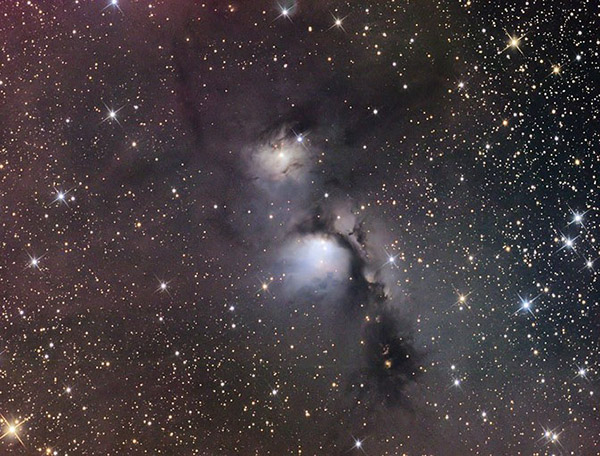
Interstellar dust blocking out the starlight behind it.
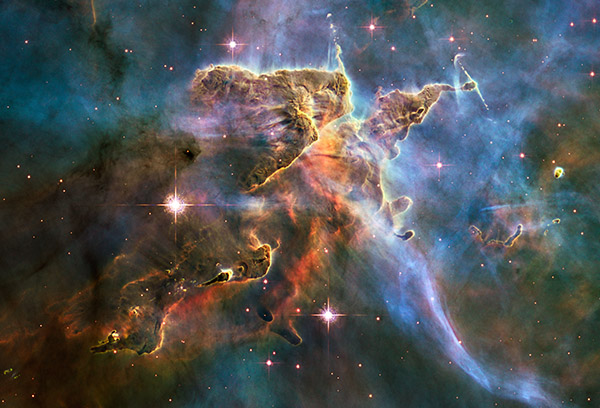
The Carina Nebula.
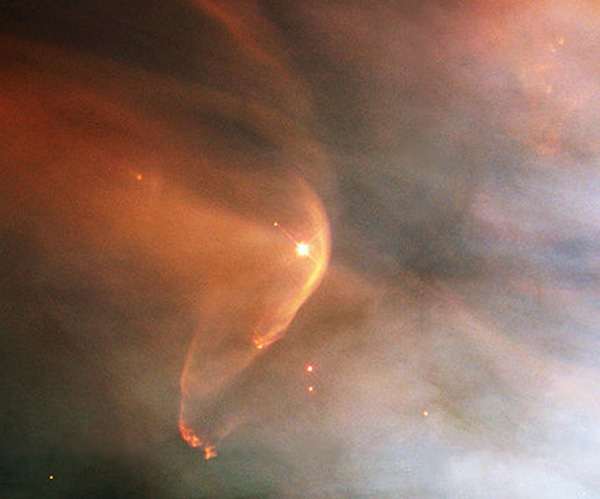
The bow shock of a star traveling through the surrounding interstellar medium.