
Planets
Planets are objects in space that are big enough to be round, yet small enough that they do not become starsStars are big, hot balls of plasma and gas that produce radiation from nuclear fusion reactions.. Planets form from protoplanetary disksA disk of gas and dust surrounding a newly formed star, from which planets, asteroids, and other objects form. surrounding newly formed stars. Dust grains in such disks collide and stick together, eventually becoming large enough that gravitational instabilityTendency for self-gravitating matter to accumulate in regions of high density, clearing out regions of low density and enhancing the contrast between the two. takes over.
Planets start off very hot but eventually cool off by emitting blackbody radiationRadiation emitted by all objects with a nonzero temperature. Blackbody radiation has a characteristic spectrum that becomes hotter and brighter with increasing object temperature. Some become terrestrial planetsA rocky or terrestrial planet is a planet with a metal core surrounded by a mantle. Terrestrial planets typically have solid surfaces. , like the EarthThe Earth is the third planet from the sun. Its average radius is 6371 kilometers and has a mass of 5.97 x 1024 kilograms. It is the only planet known to have life. . Some of these still have very hot cores, enabling liquid metals in the core to maintain a magnetic fieldsMagnetic fields are created by moving charges. These provide protection by redirecting the solar wind and other high-energy particles away from a planet's surface. Mars has a very weak magnetic field, so the solar wind has had the time to strip away its atmosphere. . In these cases the core stays hot because of radioactive decay.
Other, larger planets can become gas giantsPlanet consisting mostly of hydrogen and/or helium, much of which is in a gaseous state. Gas giants may have small solid or liquid cores. The gas giants in our Solar System are Jupiter and Saturn. -- large planets composed mostly of hydrogen or helium gas -- or ice giantsPlanet consisting mostly of methane, ammonia, or other volatile compounds, much of which is in a gaseous state. The ice giants in our Solar System are Uranus and Neptune. -- large planets composed of other volatile compounds like methane or ammonia gas. These planets create a small amount of heat by collapsing slowly under their own gravitational forces, but they are not massive enough to start fusion reactions and become stars.
MoonsNatural satellites of planets. are smaller planet- or asteroid-like bodies that orbit planets. Earth's moon (the MoonThe Moon is Earth's largest natural satellite. Compared with other moons in our star system, the Moon is rather large; it is even larger than Pluto! The Moon is responsible for the tides on the Earth. ) is thought to have been created by a giant impact involving Earth and a Mars-size body known as Theia. Not all moons form this way though; planets may also "capture" smaller bodies floating through the star system and adopt them as moons. Planets may also have ringsPlanetary ring systems appear solid, but they are actually composed of many ice particles and rocks. Four planets in our Solar System have rings: Jupiter, Saturn, Uranus, and Neptune. . Sometimes small moons (moonlets or shepherd moons) orbit within ring systems. These shepherd moons create gaps in the rings and help keep them from spreading out.
Transit light-curve simulator
Exoplanets are planets that exist outside of our solar system, orbiting their own star(s). We can detect these planets in many ways through their gravitational influence, such as the Doppler shift of their host stars, gravitational microlensing, or through photometric detection, which includes direct imaging and transits. In this section, we will focus on detecting exoplanets via the transit method. When finding a system that lies in the same plane as the observer’s perspective, we notice a similar event that occurs when an object such as Mercury, or even the moon, passes directly in front of the Sun. In the time that it takes these objects to transit the Sun, a measurable amount of sunlight is blocked out, creating a dip in the light curve. By recording the change in the Sun's light we can measure some of the object's properties. To create the following light curves and animations, we use a modified Python code originally created by Oscar Barragán to handle two types of inputs. We can create more generalized light curve models by inserting the system's physical parameters obtained from NASA’s Exoplanet Archive and academic papers. We can also plot light curve data collected by instruments such as TESS, Kepler, and others that specialize in exoplanetary research.
| System name | Number of Exoplanets | Plotted data type |
|---|---|---|
| coRot-1 | One | Data Set |
| coRot-1 | One | Parameters |
| G9-40 | One | Data Set |
| G9-40 | One | Parameters |
| HD_108236 | Five | Data Set |
| HD_108236 | Five | Parameters |
| trappist 1 | Six | Parameters |
Roche limit shearing simulator
Suppose you had a box of stuff on the Moon. How close could the Moon get to the Earth before the box of stuff is more attracted to the Earth than it is to the Moon? That distance is called the Roche LimitThe Roche Limit is a theoretical boundary based on the assumption that only gravitational forces hold an object together. Thus, there are cases where this limit does not reflect reality. . If the Moon were closer to the Earth than the Roche Limit, then we would expect the Moon to break apart and form a ring around the Earth. This simulation represents a moon as a cloud of particles and represents the planet as a point mass in the center of the simulation grid. Does the cloud form a ring when it is really close? Does it still form a ring further away? Take a look at some of the prepared simulations below!
| Orbit type | Roche limit | Apogee | Perigee | Time length |
|---|---|---|---|---|
| Circular | 80000 km | 40000 km | 40000 km | 0.53 weeks |
| Circular | 80000 km | 80000 km | 80000 km | 1.49 weeks |
| Circular | 80000 km | 400000 km | 400000 km | 16.66 weeks |
| Elliptical | 80000 km | 480000 km | 40000 km | 8.73 weeks |
| Elliptical | 80000 km | 480000 km | 80000 km | 9.75 weeks |
| Elliptical | 80000 km | 480000 km | 240000 km | 14.22 weeks |
Image credits: "ALMA image of the protoplanetary disc around HL Tauri" - ALMA (ESO/NAOJ/NRAO) (CC BY 4.0); "Great Red Spot From Voyager 1" - NASA/JPL; "Phobos colour 2008" - NASA/JPL-Caltech/University of Arizona


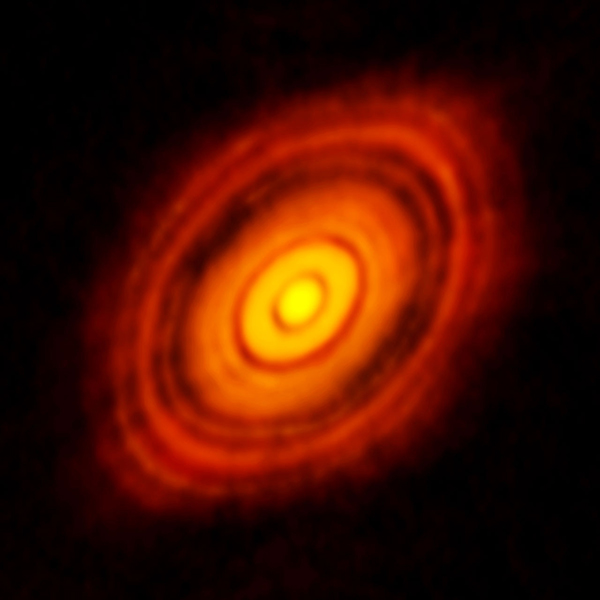
A protoplanetary disk imaged by a microwave telescope.
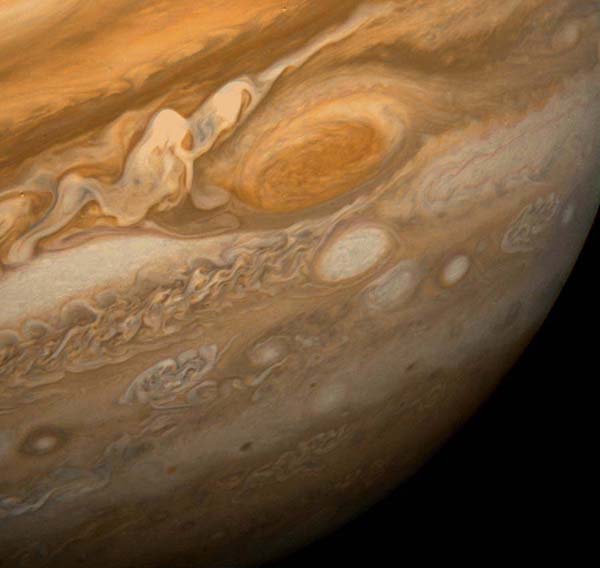
Jupiter's Great Red Spot as seen from the Voyager 1 probe.
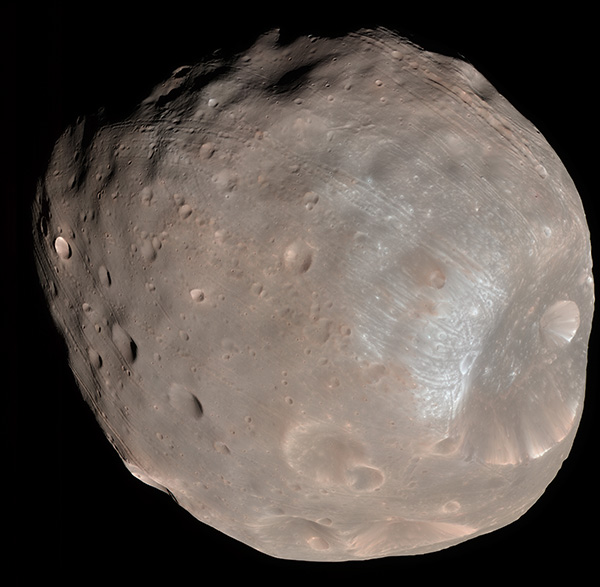
One of Mars' moons, Phobos.